Get the latest from
Eshopbox


.png)


Introduction
The retail industry in India is undergoing a major shift. More brands are moving away from traditional marketplace distributors and adopting a direct-to-consumer (D2C) model, where they sell through their own online stores or apps.
This transition is causing India's D2C market to grow rapidly and is projected to reach $300 billion by 2030. As the market expands, customer expectations continue to rise. In 2026, online shoppers demand reliable delivery timelines, clear updates, and simple returns, regardless of location. To meet these expectations, many brands now depend on ecommerce fulfillment services to maintain speed and accuracy as they scale.
In this guide, we’ll explore D2C fulfilment in 2026; what’s changing across warehousing and shipping, and how the right third party fulfillment service can help brands grow.
Let’s first understand the most common fulfilment challenges D2C brands face in 2026.
What are the key fulfilment challenges for D2C brands?
.png)
As D2C brands grow, fulfilment becomes harder to manage as order volumes increase, customer expectations rise, and manual processes fall behind. This leads to operational challenges that directly affect delivery speed, customer satisfaction, and profit margins. Here are the key challenges brands face:
1. Delays in order delivery and last-mile inefficiencies
Customers expect their orders to arrive quickly, but maintaining speed and accuracy isn't simple. Orders shipped from distant warehouses or assigned to the wrong delivery partner often get delayed. When this happens, customers lose confidence in the brand, leading to fewer repeat purchases.
2. Damaged products, packaging issues, and rising RTO rates
Packaging plays a crucial role in protecting products during transit. When items are packed incorrectly or handled poorly, they often arrive damaged, creating a poor unboxing experience. And when customers receive damaged goods, they’re more likely to return them. This not only increases RTO rates but also raises shipping costs for the brand.
3. Inefficient inventory management and forecast mismatch
Many brands still rely on manual stock management or store inventory in a single warehouse. This increases the chances of errors and often leads to stockouts during high-demand periods and excess stock during slower times. When inventory isn't distributed properly across delivery zones, shipping slows down, and transportation costs rise. Even small forecasting errors add pressure during sales and seasonal spikes.
4. Lack of integrated technology and real-time visibility
Most D2C brands use separate tools to manage orders, shipping, and inventory. When these systems don't sync properly, it can affect inventory accuracy and cause delays in orders. Without complete visibility into operations, the brand can't track order status, identify issues quickly, or make timely decisions, all of which slow down fulfilment.
5. Poor synchronisation across channels
Brands that sell across multiple channels, such as their own website, marketplaces, and sometimes offline stores, need stock levels to stay updated everywhere. When stock data is not synced properly, the chances of overselling or underselling increase. Customers may order items that are out of stock, resulting in cancellations and a poor experience.
6. High dependency on COD and delivery failures
COD still forms a large share of ecommerce orders in India, but these orders usually see higher delivery failures and RTO rates. When COD deliveries fail, brands incur extra shipping costs and lose time without completing the order. Prepaid orders are generally more reliable, but many brands lack structured systems to encourage customers to shift toward prepaid payments.
7. Increasing logistics cost and profitability pressure
Shipping costs have been rising across carriers and zones, and when a brand ships from a single warehouse or far from customers, costs increase rapidly. Additionally, returns, failed deliveries, and long transit routes reduce margins. As brands scale, managing logistics costs becomes essential for profitable growth.
What are the fulfilment models for D2C brands?
.png)
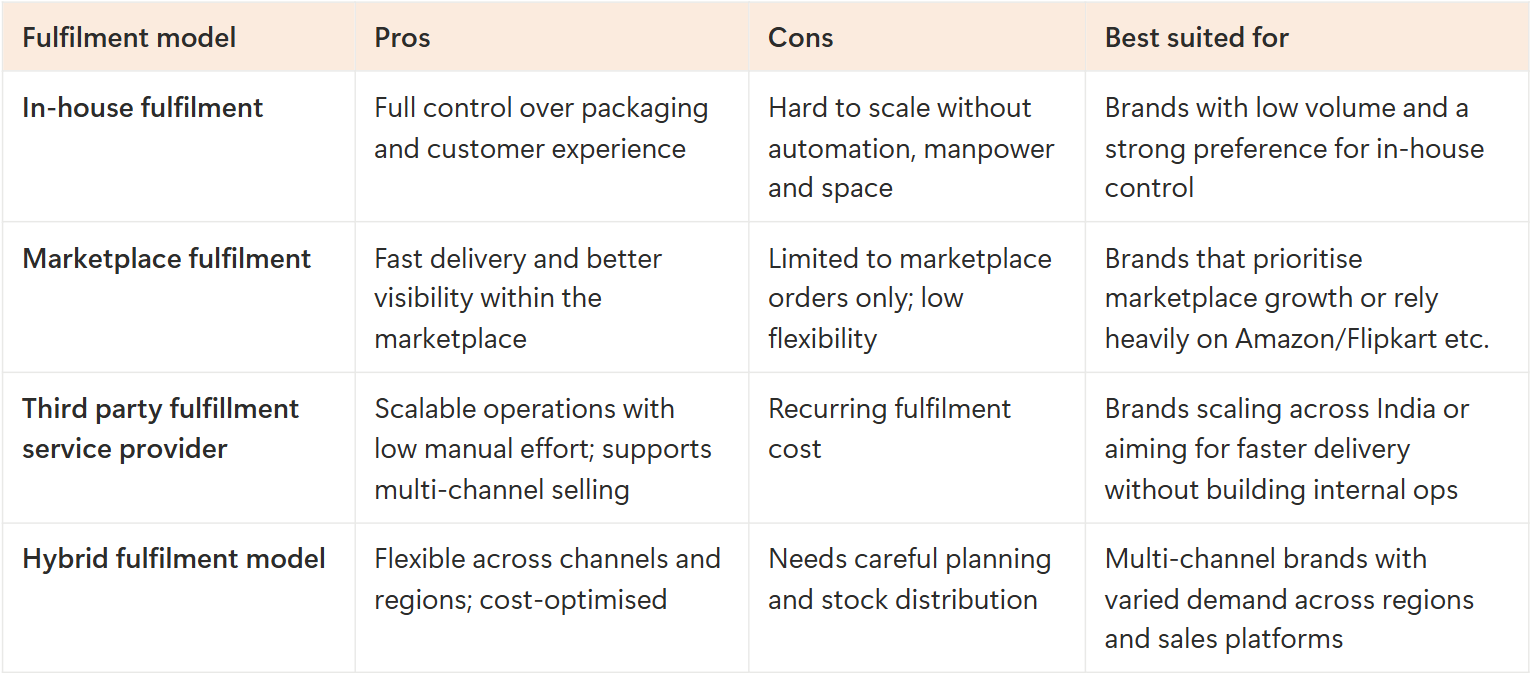
Every D2C brand handles fulfilment differently. The right choice depends on order volume, sales channels, and how fast the brand wants to grow. Each model has strengths and limitations.
Fulfilment model comparison
Fulfilment performance in 2026: Metrics and technology
Fulfilment indicators D2C brands must track
To measure fulfilment performance, D2C brands in 2026 commonly monitor:
- Order accuracy — reflects how many orders are shipped without errors
- On-time delivery — shows whether orders reach customers within the promised timeline
- RTO — measures delivery failures and return-to-origin orders
- Inventory ageing — indicates how long stock remains unsold in storage
- Fulfilment cost per order — represents the total operational cost of fulfilling one order
These indicators directly influence customer experience, repeat purchases, and profitability.
Once these indicators are measured, the next step is improving them, and that’s where technology and modern fulfillment centers for ecommerce are changing how fulfilment works in 2026.
How AI and automation are improving fulfilment metrics
In 2026, AI is no longer experimental in fulfilment; it’s operational. AI-driven systems now help brands:
- Allocate inventory to the right locations to enable faster delivery and lower shipping costs
- Select the most suitable courier for each order based on performance and delivery region
- Reduce RTO risk on COD orders with address validation and fraud checks
- Forecast demand and plan replenishment to avoid overstocking and stockouts
Together, these capabilities help brands maintain speed, accuracy, and cost efficiency even as order volumes grow.
How Eshopbox powers scalable and efficient D2C fulfilment
.png)
When D2C brands scale beyond basic setups, many move to a tech-enabled third party fulfillment service to manage scale, speed, and accuracy together. Eshopbox works as an end-to-end ecommerce fulfillment service for these brands, combining warehousing, automation, multichannel operations, and analytics in one system.
Here's how Eshopbox addresses these challenges across five key fulfilment areas:
1. All-in-one fulfilment and multichannel platform
Eshopbox allows brands to store inventory in its fulfilment centres and manage orders from D2C websites, marketplaces, B2B, and quick commerce through a single platform. This avoids the need for separate tools for each channel and keeps stock, orders, and shipping data in one place.
This setup suits brands that are selling on multiple channels and want one system to handle picking, packing, shipping, and returns instead of managing separate systems for each channel.
2. Automation-first operations and SLA-driven workflows
Eshopbox uses automation to handle repetitive tasks like order routing, inventory sync, courier allocation, and status updates. Automated, rule-based workflows help ensure that orders are processed within defined SLAs and that manual errors are reduced.
For D2C brands, this means orders move faster and more reliably from purchase to delivery.
3. Faster, more reliable delivery across India
With a distributed network of fulfilment centres across key locations such as Mumbai, Haryana, Kolkata, Bengaluru, Delhi, and Hyderabad, Eshopbox helps brands place inventory closer to customers. Its shipping integration with multiple channels uses smart courier allocation and a wide courier network to reach 29,000+ pincodes, with a focus on on-time delivery performance.
This is made possible by Eshopbox’s network of fulfillment centers for ecommerce, designed to support faster and more reliable deliveries across regions.
4. RTO control, COD management, and smoother returns
High RTO rates and failed COD deliveries can impact margins and delivery performance. Eshopbox helps brands reduce RTO by identifying delivery risks early and managing exceptions through automated workflows.
With risk scoring and NDR management, brands receive real-time alerts for failed or at-risk deliveries, allowing teams to reschedule attempts, fix address issues, or confirm customer availability before orders turn into RTOs. COD collection, reconciliation, and returns are handled through structured workflows, helping inventory move back into active stock faster.
Together, this helps brands control RTO, improve delivery success, and protect margins as order volumes scale.
5. Branded experience, visibility, and insights
Eshopbox supports branded and custom packaging options so that orders reflect the brand’s identity at the time of delivery, not just at the point of purchase.
On the operational side, teams get a unified dashboard with real-time visibility into inventory, fulfilment status, and shipping performance. Reports and analytics help track key indicators like on-time delivery, RTO, ageing, and cost trends.
This level of visibility makes it easier for brands to monitor performance, identify issues early, and make decisions based on data rather than guesswork.
Scitron — Growing D2C with Eshopbox’s fulfilment support
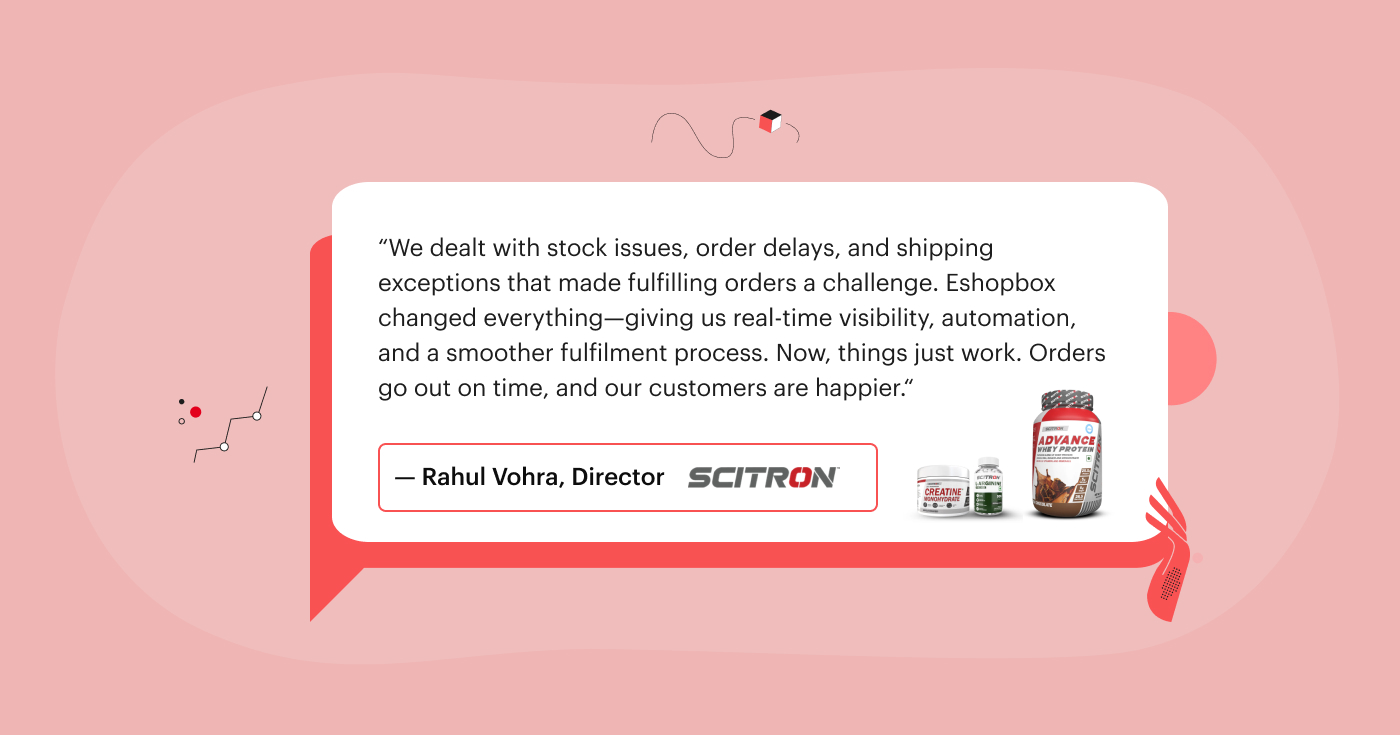
Scitron, a sports-nutrition / wellness D2C brand in India, sells via its own website, quick-commerce platforms, and major marketplaces. As sales picked up across these channels, the brand began to face common but serious operational issues: mismatched inventory across channels, stockouts and overstocking, delayed dispatches, shipping exceptions, and high return-to-origin (RTO) rates.
To overcome these, Scitron shifted its fulfilment operations to Eshopbox. With Eshopbox’s centralised inventory management, automated order processing, and warehousing with regional reach, Scitron could synchronise stock across all sales channels, streamlining fulfilment and avoiding manual errors.
The results were significant: Scitron achieved 100% SLA compliance on marketplaces, saw a 3× improvement in fulfilment speed, and recorded a 35% reduction in shipping exceptions (such as failed shipments, delays, or RTOs). This helped stabilise deliveries, improve customer experience, and gave the brand the operational stability needed to scale further.
Conclusion
For D2C brands, fulfilment is no longer just the last step in the customer journey. Reliable ecommerce fulfillment services, supported by scalable fulfillment centers for ecommerce, have become a core driver of growth. Fast and accurate deliveries, low RTO, reliable tracking, and smooth returns build customer trust, and that trust converts into repeat business and long-term profitability.
Brands that invest in scalable fulfilment early grow faster and more sustainably. They spend less time fixing operational issues and more time building products, marketing, and improving customer experience. The difference is not in getting more orders, but in fulfilling every order well. Growth doesn’t come from getting more orders; it comes from fulfilling every order well.
If you’re ready to make fulfilment your competitive advantage in 2026, book a demo with Eshopbox to see how scalable fulfilment works in practice.
Connect with our fulfilment expert today.
Talk to salesRelated Articles
Choosing the best 3PL for fashion brands in India
How Better Fulfilment Turns Year-End Sales Into Long-Term Growth
Why Indian D2C brands prefer Eshopbox over Shiprocket for fulfilment


Privacy Policy
Terms & Conditions