Get the latest from
Eshopbox




Diwali 2026 Fulfilment Checklist: What Ecommerce Brands Must Fix Before the Rush
Diwali is one of the biggest commercial periods for Indian ecommerce. It is also a major test of ecommerce scalability. The key question for Diwali 2026 is simple: Is your fulfilment infrastructure built to scale when demand and complexity increase together?
During the festive season, order volumes can increase sharply within hours. However, customers still expect accurate orders, fast delivery and clear communication. This puts pressure on inventory, picking, packing, carrier capacity and returns operations, not just warehouse staffing. Adding temporary workers or extending shifts can help, but only when the rest of the fulfilment setup can support the additional volume.
Peak-season fulfilment comes down to a well-planned system that scales with demand, in a timely, and efficient manner.
The right planning sequence is:
Expected demand → inventory positioning → warehouse capacity → packing capacity → carrier capacity → delivery promise → returns capacity
Why fulfilment breaks down during the Diwali rush
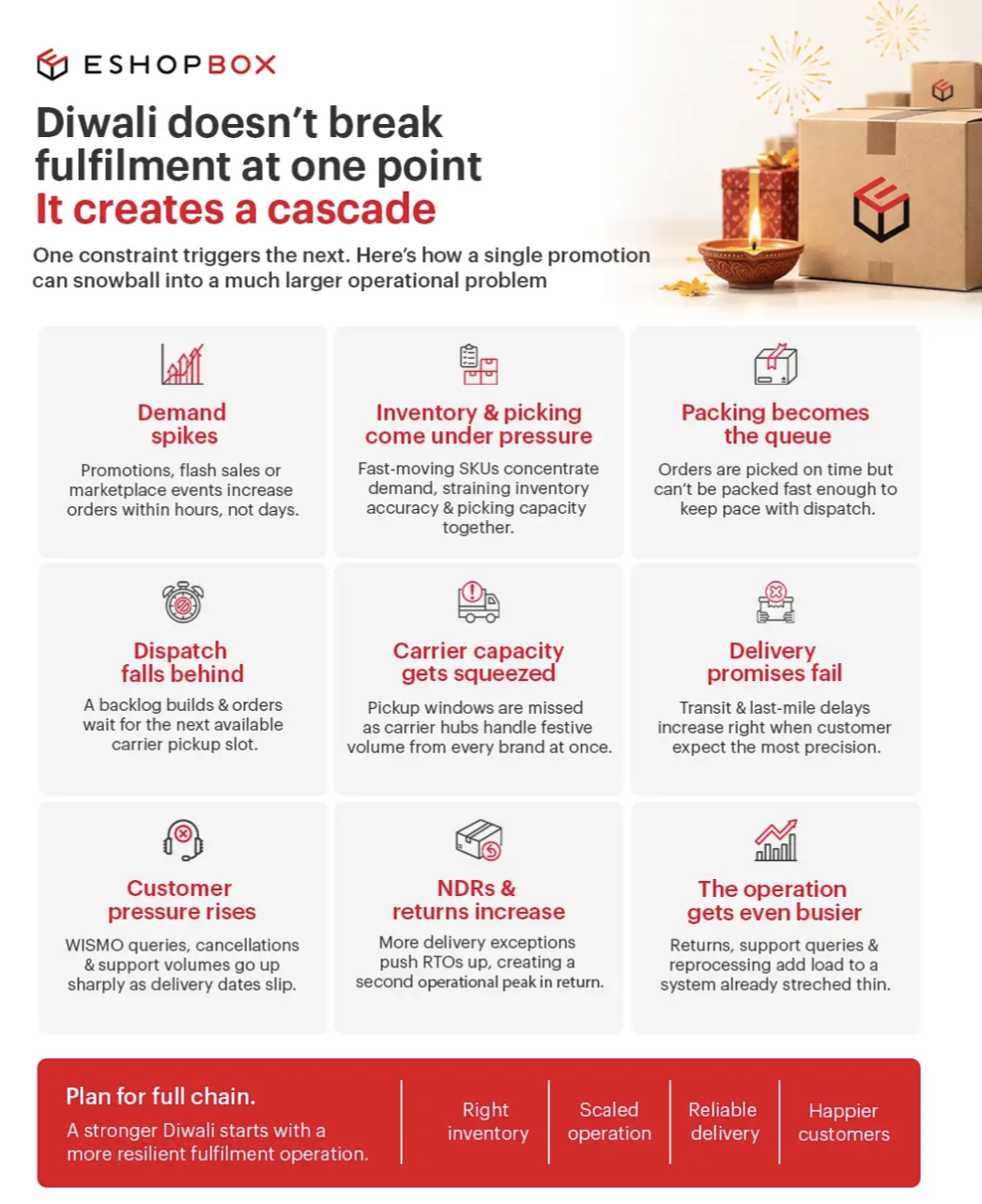
Fulfilment is a connected process, so a problem at one stage can affect the stages that follow. When demand increases, inventory and picking come under pressure. If picking slows down, orders start waiting for packing. This can delay carrier handovers and deliveries, which can then lead to more customer queries, cancellations, NDRs and returns. As these issues increase, the same teams have more work to manage.
The final delivery promise depends on every connected part of the process working smoothly and on time.

The fulfilment risks ecommerce brands should fix before Diwali
1. Demand rises faster than warehouse capacity
Festive demand can rise sharply when a campaign, flash sale, influencer mention or marketplace event performs better than expected. Warehouse capacity does not increase at the same pace. To prepare for different demand levels, brands should build three scenarios: base demand, higher-than-expected demand and a stress scenario for a sudden spike or operational disruption.
For each scenario, estimate how many orders may arrive each hour, the average number of items per order, the peak dispatch volume and the time available between receiving an order and handing it over to the carrier.
Measure peak-hour throughput rather than only looking at daily capacity. This shows whether the warehouse can keep up when a large number of orders arrive within a short period.
2. Inventory exists in the wrong place
National stock cover might look deceptively right while the right stock is unavailable where customers need it. Demand may be concentrated in one region while inventory sits elsewhere. A fulfilment centre may be out of stock while another holds excess inventory. Marketplace inventory may also be out of sync with warehouse stock.
For example, a brand sees 30 days of stock nationally, but:
Review demand by region, channel, SKU and fulfilment location. Prioritise bestsellers, promotional products, gift sets and products with long replenishment lead times. Set inventory transfer cut-off dates well before the peak because transfers require time for transport, receiving, reconciliation and system updates. During Diwali, roads, carrier hubs and warehouses operate at high capacity. Stock moved too late becomes available only after the demand spike has passed, leaving the nearest fulfilment centre out of stock even when inventory exists elsewhere.
3. Picking becomes the warehouse bottleneck
Poor product placement in the warehouse increases walking time and slows down picking. Inconsistent locations increase search time. High SKU complexity increases mispicks, while inaccurate inventory creates exception work.
Use recent demand data to re-slot fast-moving and promotion-linked products.
4. Festive packing creates hidden queues
Picked orders wait when packing stations, packers, materials, printers or quality-check resources are insufficient. Diwali orders also require more handling. Gift orders, bundles, free gifts, inserts, fragile products and marketplace packaging each add steps.
Set up processes for regular, gift, bundle, promotional, fragile and marketplace orders before the festive rush. Keep the required packaging materials and equipment ready, and test them at peak volumes. Measure the time taken from order lookup to dispatch to identify where packing delays may occur.
5. Carrier capacity makes delivery unpredictable
A warehouse can dispatch an order on time and still miss the delivery promise if carrier capacity is limited. During Diwali, carriers also face higher volumes across pickup, sorting, surface transport and last-mile delivery, which can affect delivery timelines.
The fulfilment partner should confirm carrier pickup capacity, schedules and holiday changes before the peak. It should allocate carriers based on region and service level and have backup options for critical routes. Delivery promises should also consider inventory location, warehouse processing time, carrier capacity and regional serviceability.
6. Returns and RTOs create a second peak
The workload continues after festive dispatch. Returns and return-to-origin shipments require receiving, inspection, grading, restocking, repair, repackaging or disposal. Delayed processing delays refunds and keeps saleable inventory out of stock.
Returns should be forecast separately from forward orders so the fulfilment partner can prepare enough space and staff for inspection. Before the peak, your fulfilment partner should also define clear timelines for restocking, repair, disposal, refunds and exchanges.
7. Promotions add operational complexity
Buy-one-get-one offers, bundles, coupons and free gifts create exceptions in the order flow. The operation must know which product qualifies, where the free gift is stored, how the bundle is recorded and which packaging or invoice rules apply.
Run a test of each major promotion from checkout through returns. Check that the offer rules remain consistent across ecommerce, order management, inventory, invoicing and customer communication. The brand and fulfilment partner should also define exception rules in advance, including who is responsible for each fulfilment issue.
8. Relying only on last year's sales can lead to inaccurate demand forecasts
Last year’s sales are only a starting point. Your products, prices, sales channels, customers and fulfilment setup may be different this year. The same number of orders may also create more warehouse work if customers buy more items or promotions add bundles or gift items.
Build this year’s forecast using current promotions, expected orders across your website and marketplaces, average items per order, regional demand and expected returns. Then estimate the work required: items to pick, orders to pack, cartons and labels to prepare, carrier pickups to schedule, and returns to process.
Diwali 2026 preparation timeline
Four to six weeks before Diwali
•Build base, high-demand and stress scenarios.
•Forecast demand by hour, region, channel, SKU and fulfilment location.
•Position priority inventory and complete planned transfers.
•Confirm warehouse space, staffing, packing stations and carrier requirements.
•Confirm packaging materials, promotional inserts and gift components.
Two to three weeks before Diwali
•Test picking, packing and dispatch at festive volumes.
•Confirm carrier capacity, pickup schedules and serviceability.
•Test marketplace inventory, order and fulfilment-status synchronisation.
•Test address validation, NDR and RTO workflows.
•Test major promotions from checkout through returns.
One week before Diwali
•Reconcile inventory across locations and channels.
•Confirm high-demand SKUs at the right fulfilment centres.
•Verify marketplace SLAs, carrier allocation and delivery commitments.
•Confirm return space, staffing and inspection processes.
•Publish delivery dates and order cut-offs.
During the rush and after the sale
Track orders, backlog, inventory, dispatch, carrier handover, delivery exceptions, NDRs, RTOs and returns every day. One to two weeks after Diwali, inspect returned products, separate saleable and damaged inventory, restock approved products, process refunds and review performance.
What happens when the fulfilment partner is not an expert
A peak-ready fulfilment partner goes beyond merely shipping more orders. The hallmark of a true 3PL partner for scale is one that can absorb the complexity that comes with those orders - from where inventory is positioned to how exceptions, marketplace SLAs, delivery timelines and returns are managed. Eshopbox brings the fulfilment network, technology and operational workflows together so brands can scale across channels without adding another layer of operational complexity.
A partner may perform well during normal periods and still struggle when volume, exceptions and delivery expectations rise together. The capability gaps are specific:

Questions to ask before signing a peak-season contract
Ask for measurable commitments, named owners and evidence from comparable peak periods.
•What is your committed peak capacity by day and by hour?
•Which fulfilment centres serve our demand regions, and how is inventory split between them?
•What triggers inventory movement between locations?
•What happens when actual volume exceeds the forecast?
•Which marketplaces and systems do you support, and which events are synchronised?
•How do you protect marketplace dispatch SLAs during flash sales?
•Which carriers have reserved capacity, and what is the fallback plan?
•How are NDRs, RTOs and customer delivery exceptions managed?
•What returns capacity is reserved for the one to two weeks after Diwali?
•Which metrics, dashboards and escalation thresholds are included in the contract?
•What services, peak charges and SLA remedies are included in the commercial terms?
A statement such as “we have handled large volumes before” is not a peak plan. A credible answer includes capacity numbers, assumptions, owners, timelines and escalation thresholds.
What to measure during Diwali, Big Billion Days and Great Indian Festival sale
Track these metrics at least daily and more frequently during the highest-volume sale period:
•Processing and dispatch rate: Orders received, picked, packed and dispatched, plus dispatch SLA performance.
•Inventory accuracy: Stock variance, stockouts and exception orders by location and channel.
•Warehouse throughput: Peak-hour output, queue time and backlog ageing.
•Delivery timeline: Pickup success, scan compliance, transit time and delivery performance by carrier and region.
•NDR and RTO: Failed deliveries, reasons, resolution time and return-to-origin rate.
•Returns processing rate: Return volume, inspection turnaround, refund time and recovered sellable inventory.
•Customer experience: WISMO queries, cancellations, complaints and delivery-promise misses.
Use the data to locate the next constraint. If picking output exceeds packing output, intervene at packing. If packed orders wait for pickup, adding warehouse labour does not solve the problem. If orders move from distant locations, fix inventory placement.
Conclusion
Diwali exposes the gap between normal-day performance and operational scalability. Brands that prepare only for more orders struggle when complexity rises as well. Brands that align demand, inventory, warehouse operations, carriers, systems, customer communication and returns protect the delivery promise.
The goal for Diwali should be beyond survival. It should be aimed at building a fulfillment infrastructure that scales when demand, complexity and customer expectations rise together.
Connect with our fulfilment expert today.
Talk to salesRelated Articles
Choosing the best 3PL for fashion brands in India
How Better Fulfilment Turns Year-End Sales Into Long-Term Growth
Why Indian D2C brands prefer Eshopbox over Shiprocket for fulfilment


Privacy Policy
Terms & Conditions