Get the latest from
Eshopbox




How to protect beauty products from heat damage during shipping in India
Beauty products spend hours or even days moving through warehouses, sorting facilities, delivery vehicles and last-mile networks before reaching the customer's doorstep. In India, high ambient temperatures make this journey particularly challenging for beauty brands, especially for heat-sensitive products.
Exposure to unsuitable temperatures can affect a beauty product’s texture, appearance and stability. For example, a cream may separate, a lipstick may soften, or a product containing temperature-sensitive ingredients may lose stability. The extent of these changes depends on the formulation, packaging and duration of exposure.
For beauty brands, protecting product quality requires attention at every stage of fulfilment. Storage conditions, handling practices, packaging choices and transit times all influence how products reach customers.
Here is how you can identify temperature-related risks and reduce the chances of product damage during shipping.
Which beauty products are most vulnerable to heat?
Different cosmetic formulations respond differently to temperature and humidity. Understanding these differences helps brands establish suitable storage, handling and packaging requirements for their products.
Creams, lotions and serums
Creams and lotions often contain a mixture of water, oils, emulsifiers and other ingredients. Exposure to temperatures outside their recommended storage range can affect the stability of these formulations, potentially causing separation, changes in consistency or other visible changes.
Serums also vary in their sensitivity to heat. Certain active ingredients may degrade more quickly under unsuitable storage conditions, depending on the formulation and packaging.
What brands should do: Review product-specific storage recommendations and establish suitable handling procedures. During quality checks, look for changes in consistency, colour, appearance or packaging integrity that may indicate a product issue.
Lipsticks and cream-based makeup
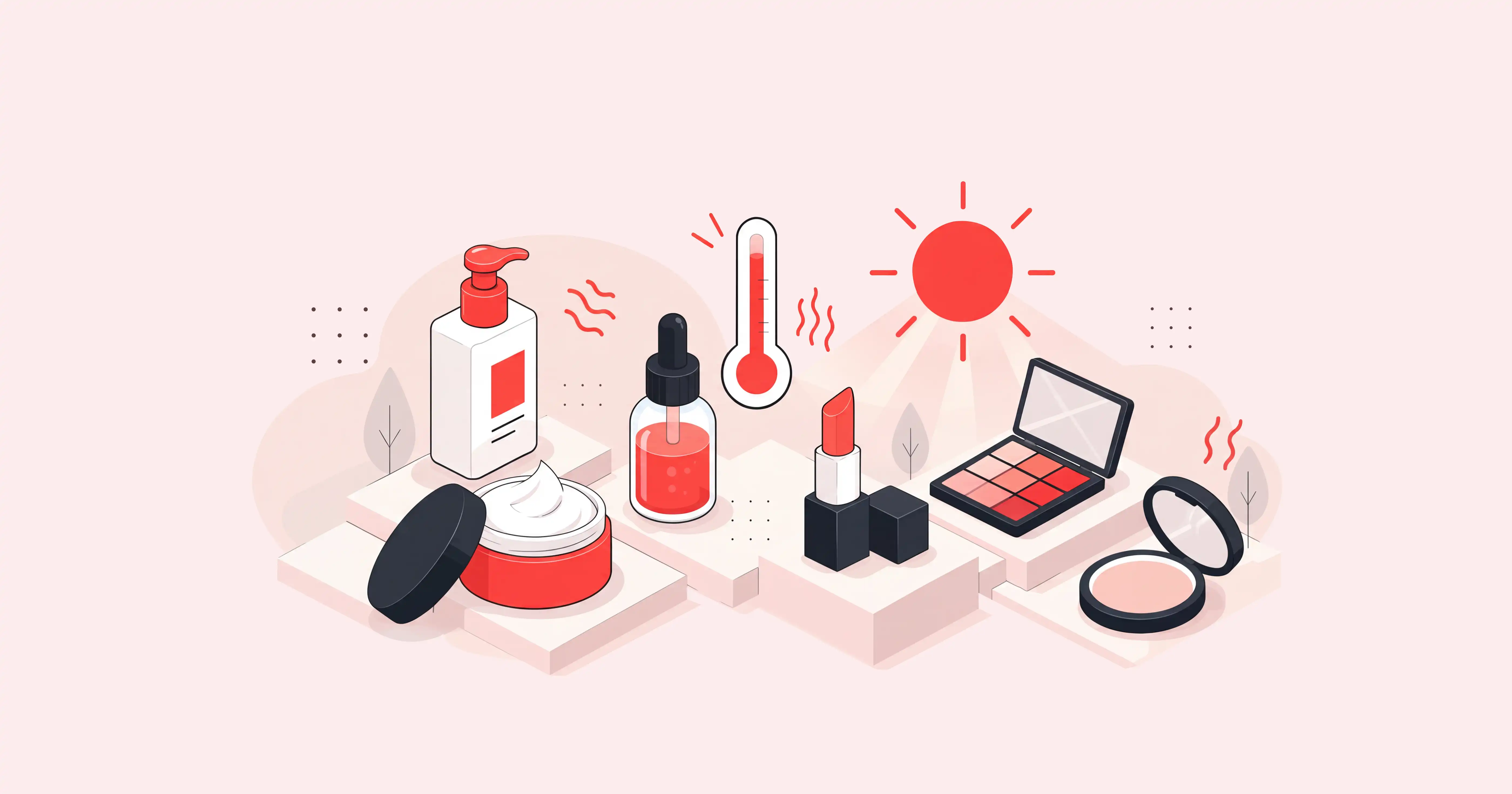
Lipsticks, cream blushes, concealers and similar products can be sensitive to elevated temperatures because their texture depends partly on the properties of their waxes, oils and other ingredients.
Excessive heat may soften these products, cause deformation or make them difficult to apply. Products may also become messy inside their packaging if they soften during storage or transit.
What brands should do: Use packaging that protects the product from physical damage and keeps the container securely closed. Identify products that require additional temperature precautions and avoid leaving them exposed to unsuitable conditions during handling and dispatch.
Powders and palettes
Powder-based products such as eyeshadows, compact powders and pressed blushes are generally less susceptible to heat-related softening than cream-based makeup. However, moisture and humidity can still affect them.
When powders absorb moisture, they may become caked or difficult to apply. Heat and humidity can also affect packaging materials and adhesives, depending on the product.
What brands should do: Keep products in dry storage conditions appropriate to their requirements. Ensure packaging protects powders from moisture, impact and accidental opening during transit.
Products with specific storage requirements
Some beauty products have storage requirements that differ from those of the rest of the catalogue. Certain formulations may need protection from excessive heat, direct sunlight or significant temperature fluctuations.
Treating every product the same way can create avoidable risks, particularly when a brand sells skincare, makeup, fragrances and other beauty products together.
What brands should do: Document storage and handling requirements at the product or SKU level. Use manufacturer guidance to determine whether particular products need additional precautions, specialised packaging or temperature-controlled handling.
Where can heat damage happen in the fulfilment journey?
Heat exposure can occur at several points between the warehouse and the customer's doorstep. Identifying these points helps brands focus on the conditions they can control.

1. At the warehouse
Products may remain in storage for days or weeks before an order is placed. If the storage area experiences unsuitable temperatures, inventory can be exposed to those conditions long before dispatch.
This risk can increase in warehouses with poorly ventilated areas, direct sunlight exposure or limited monitoring of environmental conditions.
How to reduce the risk: Store cosmetics according to their recommended conditions. Keep inventory away from direct sunlight and unsuitable heat sources, and monitor storage areas where temperature-sensitive products are kept. Where a product requires controlled temperatures, ensure the storage setup can maintain the specified range.
2. During picking and packing
Once an order is received, products move through picking, packing and dispatch preparation. During this period, cosmetics may spend time outside their designated storage areas.
Delays can increase exposure, especially when products sit in staging areas or remain unpacked while awaiting order processing.
Packaging also matters at this stage. A poorly secured container may leak, while inadequate cushioning can let products break or get damaged during handling.
How to reduce the risk: Organise picking and packing workflows to minimise unnecessary waiting. Use packaging suited to the product's size, fragility and storage requirements. For products that need additional temperature protection, evaluate suitable insulated packaging or other validated solutions.
3. During loading and carrier handover
After packing, shipments may wait for carrier collection or spend time in loading and unloading areas. During hot weather, vehicles and exposed staging areas can become significantly warmer than the surrounding indoor environment.
Repeated delays at this stage can increase the time a shipment spends in unsuitable conditions.
How to reduce the risk: Align warehouse processing schedules with carrier pickup times. Keep packed orders in appropriate holding areas until collection and avoid unnecessary exposure to direct sunlight or hot surfaces. Temperature-sensitive shipments may require specific handover procedures based on their storage requirements.
4. During transit and last-mile delivery
Once a shipment leaves the warehouse, the brand has less direct control over its environment. Delivery vehicles, sorting facilities and temporary holding areas may expose products to elevated temperatures.
Longer transit times and repeated handling can extend exposure. A shipment delayed in a hot environment may face greater risk than one that reaches the customer sooner, although the actual outcome depends on the product and the conditions encountered.
How to reduce the risk: Choose carriers based on serviceability, reliability and transit performance. Monitor delayed shipments and investigate recurring issues by route or destination. Where products require temperature-controlled transport, ensure the carrier and packaging arrangements can meet those requirements.
A distributed fulfilment network can help reduce unnecessary transit distance by positioning inventory closer to customer demand. However, shorter routes should complement appropriate storage and handling practices rather than replace them.
What should beauty brands look for in their fulfilment setup?
Preventing heat-related product damage requires more than checking whether a shipment arrived on time. Brands also need fulfilment processes that protect inventory quality before and during dispatch.
Product-specific quality checks
A single quality-check process may not be suitable for every beauty product. The checks needed for a sealed skincare bottle can differ from those required for a lipstick, pressed powder or glass fragrance bottle.
Product-specific quality checks should cover the conditions relevant to each item.
Depending on the product, these may include:
- Expiry dates and batch information
- Colour, texture and visible product condition
- Container integrity, leakage and damaged seals
- Packaging condition and hygiene requirements
- Signs of separation, deformation or other unusual changes
Quality checks at receiving help identify existing product issues before inventory becomes available for sale. Apply additional checks where product requirements or handling risks make them necessary.
Proper inventory storage
After receiving and quality checks, store products in locations that suit their requirements.
Brands should understand where each SKU is stored, whether the storage conditions are appropriate and how inventory moves between locations. This is especially important when stock is distributed across several fulfilment centres.
Clear inventory records also help teams identify which products are available at each location and investigate discrepancies before they affect order fulfilment.
For products with specific temperature requirements, storage procedures should include suitable monitoring and escalation processes when conditions move outside the recommended range.
Batch and expiry management
Beauty products have varying shelf lives, and some formulations may require additional attention to storage history or batch traceability.
Without reliable batch and expiry records, teams may struggle to identify which products should be prioritised for dispatch or which inventory may need inspection following a storage issue.
First-expiry-first-out (FEFO) helps prioritise inventory with the earliest expiry date for dispatch, provided the stock is suitable for sale and the order requirements allow it.
Batch-level traceability also helps brands identify affected stock if a particular batch needs investigation, quarantine or recall.
Protective packaging
Packaging must protect cosmetics from the risks they may encounter during handling and delivery.
For example, glass bottles may require cushioning to prevent breakage, while liquid products need secure closures and leak protection. Cream-based makeup may need packaging that prevents mess or damage from deformation during transit.
For products sensitive to elevated temperatures, brands should assess whether additional insulation or specialised packaging is appropriate. Evaluate such solutions based on expected transit duration and environmental conditions.
Insulated packaging alone does not guarantee that a product will remain within its required temperature range. When strict temperature limits apply, validate packaging and transport arrangements against those requirements.
Faster, shorter delivery routes
The distance between a fulfilment centre and the customer influences how long a product spends in transit. Longer routes can also add handling stages and create opportunities for delays.
Positioning inventory closer to high-demand regions can help reduce transit distances and improve delivery speed.
However, inventory placement needs to account for demand patterns, stock availability and storage conditions at each location. Distributing products across multiple warehouses is useful only when each location can manage the inventory appropriately.

What Eshopbox does differently for beauty fulfilment
Beauty fulfilment requires processes that account for product condition, shelf life, packaging needs and delivery timelines. Eshopbox supports beauty brands through fulfilment capabilities designed to manage these operational requirements.
- QC at receiving: Product-specific checks help identify visible damage, condition issues and other discrepancies before inventory becomes available for sale.
- Batch and expiry tracking: Inventory records support batch-level traceability and expiry-based stock management, helping teams manage products according to their shelf life.
- Secure storage and inventory visibility: Visibility across fulfilment centres helps brands track stock locations and understand where inventory is available.
- Protective packaging: Packaging workflows can be aligned with product requirements to reduce the risk of leakage, breakage and other physical damage during fulfilment.
- Distributed fulfilment: Positioning inventory closer to demand can reduce unnecessary transit distance and support faster delivery to customers.
These capabilities address different parts of the fulfilment journey. Product quality checks help identify issues, inventory controls support traceability, and distributed fulfilment can reduce transit distance. Products that require temperature-controlled storage or transport still need arrangements that meet their specific requirements.
A practical heat-protection checklist for beauty brands
Use this checklist to review your current fulfilment processes and identify areas that may need attention.
- Identify heat-sensitive products: Document storage requirements for each relevant SKU using manufacturer guidance.
- Define product-specific QC checks: Establish checks for expiry, colour, texture, seals and product condition where applicable.
- Track batches and expiry dates: Maintain traceability and use FEFO where appropriate.
- Review warehouse storage conditions: Check for direct sunlight exposure, unsuitable heat sources and temperature variations in storage areas.
- Evaluate packaging requirements: Assess whether products need cushioning, leak protection, insulation or specialised packaging.
- Reduce unnecessary transit distance: Review order distribution and consider positioning suitable inventory closer to demand.
- Monitor delayed shipments: Investigate shipments that exceed expected transit times, particularly those containing temperature-sensitive products.
- Inspect heat-damaged returns: Assess returned products for changes in texture, appearance, packaging integrity or other relevant quality concerns before deciding whether they can be restocked.
- Review damage and return patterns: Compare product issues by SKU, batch, fulfilment centre, carrier and destination to identify recurring problems.
Conclusion
Heat-related damage can begin well before a customer opens a package. Unsuitable storage conditions, handling delays, and prolonged transit can affect cosmetics, depending on their formulation and temperature sensitivity.
For beauty brands, the priority is to understand each product's requirements and build fulfilment processes around them. Product-specific quality checks, appropriate storage, reliable batch tracking, suitable packaging and shorter delivery routes can help reduce avoidable risks.
Eshopbox supports beauty fulfilment through inventory management, quality checks, batch and expiry tracking, packaging workflows and a distributed fulfilment network. By combining these operational controls with suitable temperature-protection measures where required, brands can better manage product quality throughout the order journey and deliver a more consistent customer experience.
Connect with our fulfilment expert today.
Talk to salesRelated Articles
1-day delivery fulfilment checklist for ecommerce brands
Festive sale readiness: 3PL pre-sale audit guide
Diwali 2026 fulfilment checklist for ecommerce brands


Privacy Policy
Terms & Conditions