Get the latest from
Eshopbox


To reduce RTO in ecommerce India, D2C brands need to address the problem at three stages — before dispatch, during delivery, and after a failed attempt. The average RTO rate for Indian ecommerce is 20-40%, with COD orders accounting for over 60% of all returns. Brands that bring RTO below 10% typically combine address verification, COD-to-prepaid conversion, NDR automation, and distributed fulfilment from a single platform.
This guide covers the 10 most effective strategies to reduce RTO for ecommerce brands in India, the real cost of high RTO, and how to implement each fix — whether you manage fulfilment in-house or through a 3PL like Eshopbox.
What is RTO in ecommerce and why does it happen in India?
RTO stands for Return to Origin. It occurs when an order cannot be delivered to the customer and is returned back to the warehouse from where it was shipped.
For example, an ecommerce brand receives an order from Pune. The brand stores inventory across multiple warehouses in India. The order is allocated to the nearest warehouse — Mumbai. If the customer is unavailable or refuses delivery, the courier marks the order as RTO and sends it back to the originating warehouse in Mumbai.
In India, 1 out of every 3 ecommerce orders may end up as RTO, largely due to operational and behavioural factors unique to the market.
The most common causes include:
- Cash on Delivery (COD) orders — COD orders have the highest refusal rates
- Wrong or incomplete delivery addresses
- Customer unavailability during delivery attempts
- Delayed deliveries after the customer's need date
What does RTO actually cost your ecommerce business?
RTO is not just a returned order — it creates multiple layers of financial loss for ecommerce brands.

For a brand shipping 5,000 orders per month with a 25% RTO rate, these losses can translate into ₹8–15 lakh in logistics and operational costs every month.
This is why reducing RTO is one of the highest-impact optimisations for ecommerce profitability in India.
Why are RTOs a nightmare for ecommerce brands?
For ecommerce brands, RTOs are difficult to manage because they involve several operational and financial costs, including:
- Forward shipping and return shipping costs
- Blocked inventory while items are in transit
- Quality check and re-packaging of returned items
- Refurbishment and restocking of returned products
- Operational resources used in processing returns
The situation is even worse for cash on delivery orders, where customers refuse to pay for the order and brands must still bear shipping and COD handling charges.
Higher RTO rates also signal problems in the fulfilment process. If products are delivered late, incorrect, faulty, or inaccurate, it indicates that the shipping and delivery experience needs optimisation.
How to reduce RTO in ecommerce India — 10 proven strategies
Below are the most effective strategies ecommerce brands use to reduce RTO rates in India.
1. Convert COD orders to prepaid
Cash on delivery orders have 3x higher RTO rates than prepaid orders.
To encourage prepaid payments:
- Offer ₹30–50 discount incentives for prepaid orders
- Send post-order WhatsApp payment links
- Use automated COD-to-prepaid conversion workflows
This single step can significantly reduce RTO rates.
2. Implement address verification at checkout

Wrong addresses are one of the top reasons for failed deliveries in India.
You can prevent this by:
- Using Google Maps API address validation
- Making pincode verification mandatory
- Sending automated address confirmation messages before dispatch
These steps ensure the delivery location is accurate before shipping.
3. Use a risk score to flag high-risk orders
Not all orders carry the same RTO risk.
AI-based risk scoring can analyse:
- Customer delivery history
- Order value
- Delivery location
- Payment method
High-risk orders can be held for manual review or converted to prepaid before dispatch.
Platforms like Eshopbox's Risk Score feature automate this process.
4. Automate NDR (Non-Delivery Report) management
When a delivery attempt fails, brands usually have 24 hours to intervene before the order is marked RTO.
Automated NDR workflows help by:
- Sending instant WhatsApp or SMS alerts to customers
- Allowing customers to reschedule delivery or update addresses
- Automatically notifying courier partners
This process can recover 30–40% of failed deliveries.
5. Reduce delivery time with distributed warehousing

Late deliveries often lead customers to refuse orders.
Storing inventory across multiple fulfilment centres across India helps reduce delivery time from 5–7 days to 1–3 days.
Faster delivery reduces:
- Occasion-based refusals
- Customer cancellations
- Failed deliveries
Eshopbox enables this with a distributed network of fulfilment centres across India.
6. Send proactive delivery notifications
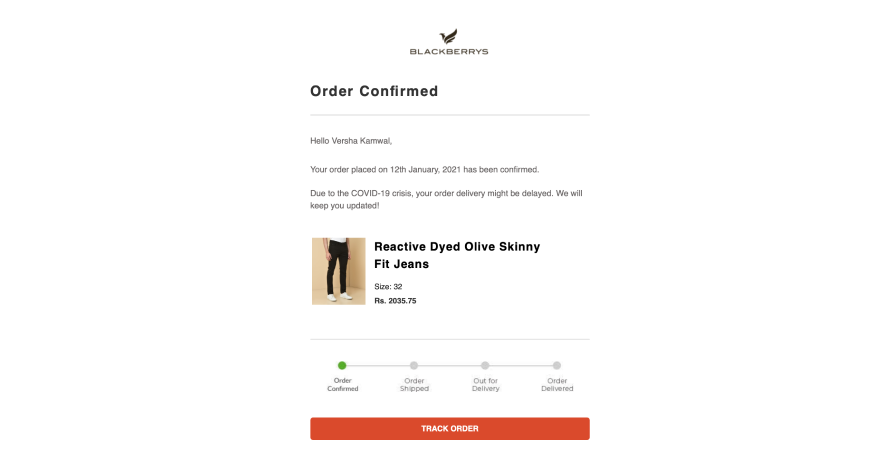
Customers are less likely to miss deliveries when they know exactly when their order will arrive.
Send notifications across multiple channels:
- SMS
Notify customers during:
- Order dispatch
- Out-for-delivery
- Delivery attempt stages
This reduces missed deliveries significantly.
7. Improve product listings to reduce expectation mismatch
Returns caused by product not matching expectations are completely preventable.
Improve your product pages by:
- Adding multiple high-resolution product images
- Including accurate sizing charts
- Showing product videos and usage demonstrations
- Displaying authentic customer reviews
These steps ensure customers know exactly what they are purchasing.
8. Offer delivery date selection
Allowing customers to choose a preferred delivery date during checkout helps avoid occasion-based refusals.
Customers can plan delivery around:
- Travel schedules
- Events or special occasions
- Availability at home
This small feature can significantly reduce RTO rates.
9. Blacklist serial returners and fraud accounts
A small group of customers often account for a large portion of RTO orders.
Brands should identify and monitor:
- Frequent COD returners
- Suspicious ordering patterns
- Fraudulent customer behaviour
These customers can be blocked or restricted from placing COD orders.
10. Implement OTP-based delivery for high-value orders
For high-value orders (₹2,000–₹3,000+), OTP-based delivery verification ensures the package is received by the correct person.
Benefits include:
- Preventing fake delivery attempts
- Reducing courier fraud
- Ensuring successful delivery confirmation
How Eshopbox reduces RTO for D2C brands
Eshopbox provides multiple platform features designed to reduce RTO rates for ecommerce brands.
These include:
- Risk Score: automatically flags high-risk orders before dispatch
- NDR Automation: real-time alerts and customer self-service rescheduling
- COD-to-Prepaid Conversion: automated WhatsApp workflows with incentives
- Distributed fulfilment network: inventory stored across multiple Indian cities
- RTO analytics dashboard: track RTO by courier, location, and product category
- Branded customer portal: customers can reschedule deliveries without contacting support
Together, these tools help brands reduce delivery failures and improve order success rates.
RTO benchmarks by category in India (2026)
RTO rates vary widely across ecommerce categories.
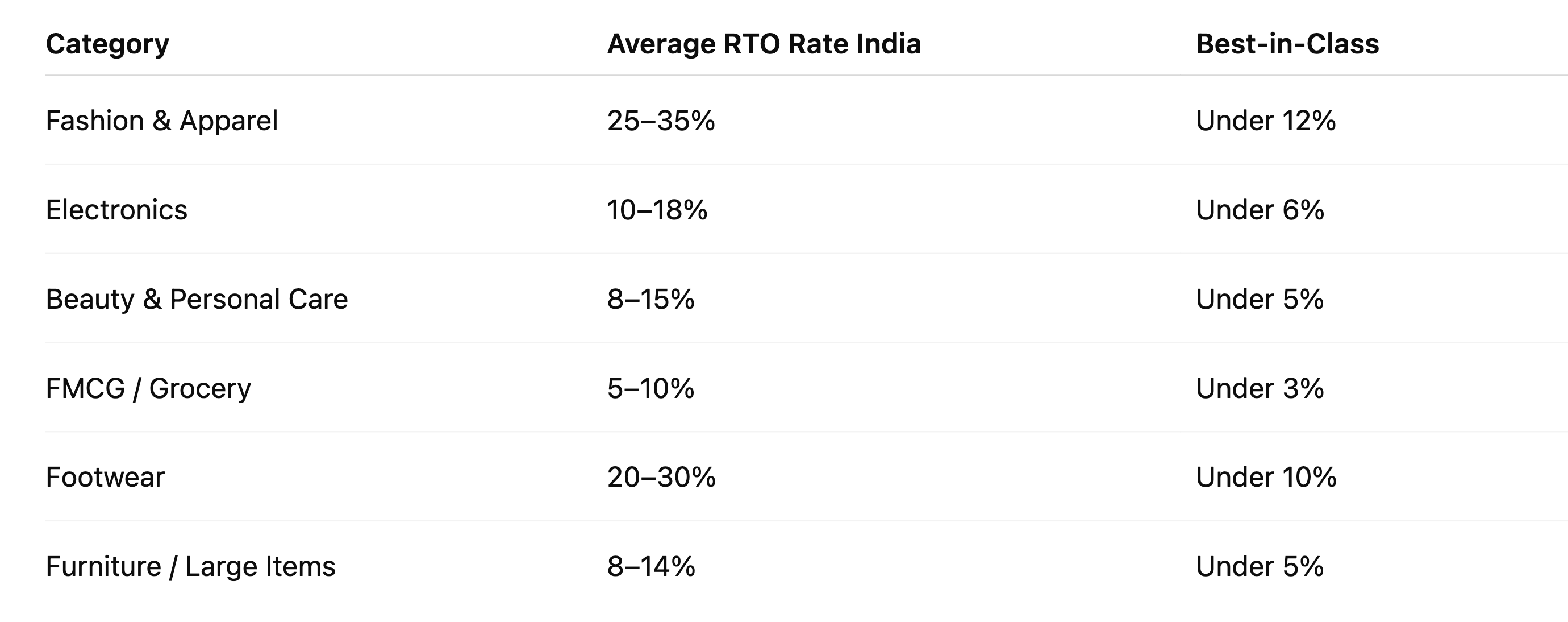
Brands that consistently maintain RTO below 10% usually combine automation, faster delivery, and proactive customer communication.
Bottom line
Efficient return management plays a crucial role in ecommerce profitability. By implementing the right strategies and leveraging automation, brands can significantly reduce RTO rates and the associated costs.
External fulfilment partners like Eshopbox can accelerate this process by providing the infrastructure and technology needed to optimise deliveries and reverse logistics.
Ultimately, reducing RTO not only protects your margins but also improves the overall customer experience and operational efficiency of your ecommerce business.
Connect with our fulfilment expert today.
Talk to salesRelated Articles
1-day delivery fulfilment checklist for ecommerce brands
Festive sale readiness: 3PL pre-sale audit guide
Diwali 2026 fulfilment checklist for ecommerce brands


Privacy Policy
Terms & Conditions